
Healing Through Music, Dance, and Visual Art
In our fast-paced, often verbal-heavy world, we sometimes reach a limit where words simply aren’t enough to describe what we feel. Whether it is the weight of stress, the complexity of grief, or the quiet hum of anxiety, these emotions often live in the body and the subconscious, beyond the reach of traditional conversation.
For children with ADHD, Autism Spectrum Disorder (ASD), or sensory processing sensitivities, certain activities provide a “low-stakes” environment where they can succeed without the social pressure of traditional classrooms.
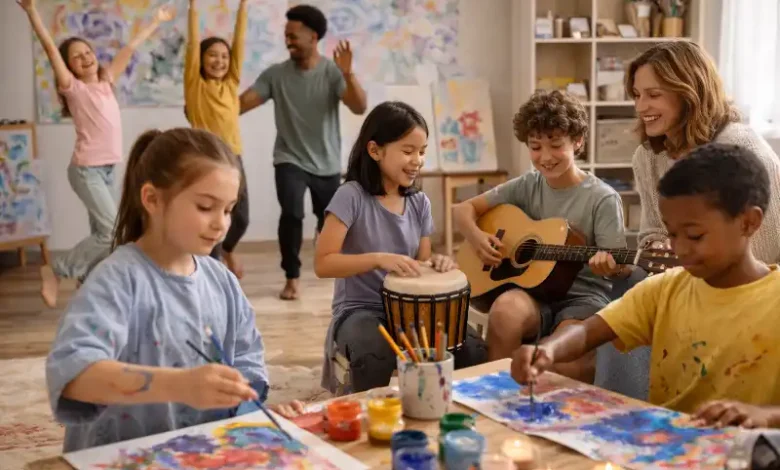
Expressive Arts Therapy offers a bridge. By integrating music, dance, and visual arts into the healing process, we tap into the “right brain”—the seat of intuition, emotion, and creativity—to facilitate a deep, holistic release that standard talk therapy might miss.
The Triad of Creative Healing
While each modality has its own unique “language,” they work in harmony to align your mind, body, and spirit.
1. The Rhythm of the Soul: Music Therapy
Music is one of the few activities that involves using the whole brain. It isn’t about being a virtuoso; it’s about the vibration and the frequency of sound.
- Active Expression: Playing an instrument or drumming can release pent-up frustration and provide a sense of agency.
- Receptive Healing: Simply listening to specific frequencies can lower cortisol levels, regulate heart rates, and move us into a meditative state.
- The Benefit: It bypasses the “logical” mind to provide immediate emotional regulation.
2. The Language of the Body: Dance & Movement
We often store trauma and tension in our muscles and fascia. Dance (or Movement) Therapy treats the body as a primary messenger.
- Somatic Release: Moving to a rhythm allows the body to shake off stagnant energy and “stuck” emotions.
- Mind-Body Connection: It helps individuals reconnect with their physical selves, fostering body positivity and grounding.
- The Benefit: It turns “feeling” into “doing,” providing a physical outlet for internal shifts.
3. The Mirror of the Mind: Drawing & Painting
Visual art serves as a physical manifestation of the internal landscape. When you put a brush to canvas or a pencil to paper, you are externalizing your inner world.
- Non-Verbal Communication: You can “paint” a feeling that you don’t yet have a name for.
- Color Theory: Using specific hues can influence your mood—blues for calm, yellows for energy, or reds for processing anger.
- The Benefit: It provides a safe distance. Once a feeling is on the paper, you can look at it, analyze it, and eventually, transform it.
Therapeutic Value for Neurodivergent Youth
1. Executive Function & Focus
ADHD often involves a struggle with “sequencing”—the ability to follow steps in order. Engaging in a structured hobby (like building models, coding, or baking) acts as an external scaffold for the brain.
- The Benefit: It practices the “start-to-finish” loop, helping kids learn to break large tasks into manageable micro-steps.
- The Science: Completing these small steps provides frequent “dopamine hits,” which can improve sustained attention over time.
2. Sensory Regulation
Many neurodivergent teens experience sensory overload. Repetitive, tactile activities—often referred to as “stimming” or sensory play—help ground the nervous system.
- The Benefit: Activities involving textures (clay, sand) or repetitive motions (knitting, sorting, rhythmic movement) can lower cortisol levels and help a child transition from a state of “meltdown” to a state of “flow.”
3. Emotional Safety & Self-Esteem
Traditional social environments can be exhausting for neurodivergent kids who feel they must “mask” their true selves.
- The Benefit: Mastery of a specific skill provides a sense of competence. When a child creates something tangible, it builds a self-narrative of “I am capable,” which counters the frustration they might feel in other areas of life.
Is Expressive Arts Therapy Right for You?
You do not need to be an “artist” to benefit from these practices. In fact, some of the most profound breakthroughs happen when we let go of the need for the end result to look “good” and instead focus on how the process feels.
If you find yourself stuck in repetitive thought patterns, feeling disconnected from your body, or simply seeking a more vibrant way to explore your personal growth, the arts may be the key that unlocks your next chapter of healing.
“Art washes away from the soul the dust of everyday life.” — Pablo Picasso
